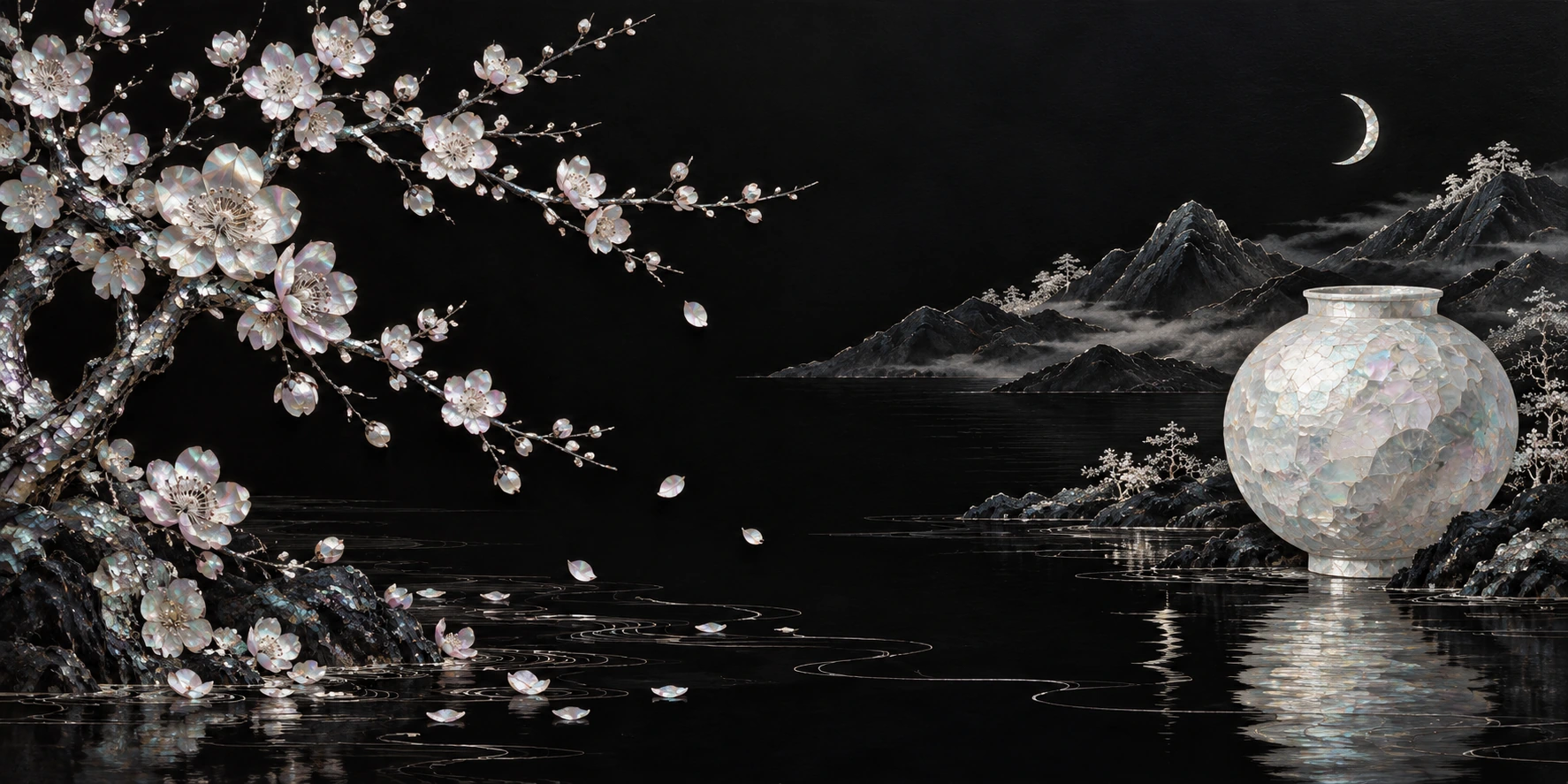
The Met explains Goryeo celadon through the clay and glaze ingredients, including iron, and a kiln atmosphere with reduced oxygen. In sanggam decoration, makers incise a pattern, fill it with contrasting slips, then glaze and fire it. Ceramic inlay uses clay slips; najeon uses shell.
Make and smooth the wooden body; build the prepared lacquer surface.
02 / 도안·재단
Draw & cut
Plan the motif and cut shell to suit its shapes or fine lines.
03 / 붙이기
Place the shell
Arrange and adhere the pieces to the design.
04 / 칠·연마
Lacquer & finish
Continue lacquering, reveal the shell and polish the surface. The sequence varies with the technique.
Meet a documented maker+
LEARN FROM A DOCUMENTED MAKER
Lee Hyung-man · 이형만
The Korea Heritage Agency’s profile documents his training with Kim Bong-ryong and shows drawing, shell cutting, lacquer removal and polishing. Its process photographs and film offer a closer look at the actual work.
Hold the ground fabric in a frame before stitching.
03 / 수놓기
Build the motif
Use outline or filling stitches to give the drawing its surface.
04 / 마무리
Finish the work
The documented traditional process includes cleaning, securing the reverse and drying before removing the frame.
Bojagi is the cloth; jogakbo is one way of making it +
A bojagi is a square cloth for wrapping or covering. Its constructions include single-layer, lined, padded, quilted and patchwork examples. Jogakbo is made by joining pieces of fabric. A single-piece wrapping cloth need not be called patchwork.
Charim — A Tea Diary keeps the idea of a carefully made writing object in a contemporary hardcover format. Its design is not a reproduction of a five-hole-bound historical book.
Cham-seon, or Seon meditation, is among the Buddhist practices introduced through Korea’s Templestay programs.
At home: sit comfortably for a short quiet pause and notice your natural breathing. This simple exercise is inspired by stillness; formal Seon practice has its own teaching and context.
Korea’s forest welfare programs use the landscape, sounds and other features of forests as settings for guided activities.
In everyday life: take an easy walk along a nearby tree-lined path. Notice the light, leaves and sounds. This is a personal pause, separate from a guided forest therapy program.
04찜질방Time to rest togetherCONTEMPORARY BATHHOUSE CULTURE+
Korean jjimjilbangs combine bathing or heated rooms with shared places to rest, eat and spend time together.
For the brand: the useful idea is a deliberate transition from activity to rest. A warm wash and a quiet pause at home are our own adaptation, rather than a recreation of a jjimjilbang visit.
These practices have different histories. Our short home sequences are everyday adaptations, not formal cultural programs, medical treatments or promises of health outcomes.
READ A LITTLE FURTHER
The tradition behind the idea.
Sources that inform our approach to Korean tea. Charim is an independent modern interpretation, not a formal court ceremony or an endorsed cultural program.
Asian Art Museum
Korean Tea Ceremony
Tea master Youngmi Yi and scholar Jaesup Pak introduce darye and Korea’s flexible approach to preparing and enjoying tea.